Nick Rae’s aviation workbook series · 02 / Instrument rating
Instrument Rating Workbook
Connect the procedure to the decision.
Practice the explanation behind an IFR answer: the source, the assumptions and the limit that matters. Bring weather, systems, navigation and approach study into one repeatable routine.
Retailer checkout. Confirm current price, availability and selected format on Amazon.
See the sample
The right fit
What you’ll work on.
For pilots working toward an instrument-airplane rating, or reviewing IFR knowledge alongside a CFII. The exercises are a place to practice explanations before applying them in instructor-led training.
Instrument-airplane study organized around preflight preparation, systems, ATC procedures, instrument flight, navigation, approaches, emergencies and postflight review.
Prepare for the flight
Pilot qualifications, weather information and cross-country planning.
Understand the airplane
Preflight procedures and instrument/navigation-system questions, including the dual-VOR example below.
Work through ATC and navigation
Clearances and procedures, flight by reference to instruments, and navigation systems.
Discuss approaches and abnormal situations
Instrument approach procedures, emergency operations and postflight procedures.
Compare with the answer key
Written exercises and scenario prompts connect to a consolidated answer section in the First Edition source.
These groups follow the First Edition (2026), Version 1.0 (February 2026) manuscript. Its printed references are dated; use the current FAA publications and your CFII to check them.
Look before you buy
Try the dual-VOR question.
One small exercise from the workbook, with its original answer and a clearly bounded source check.
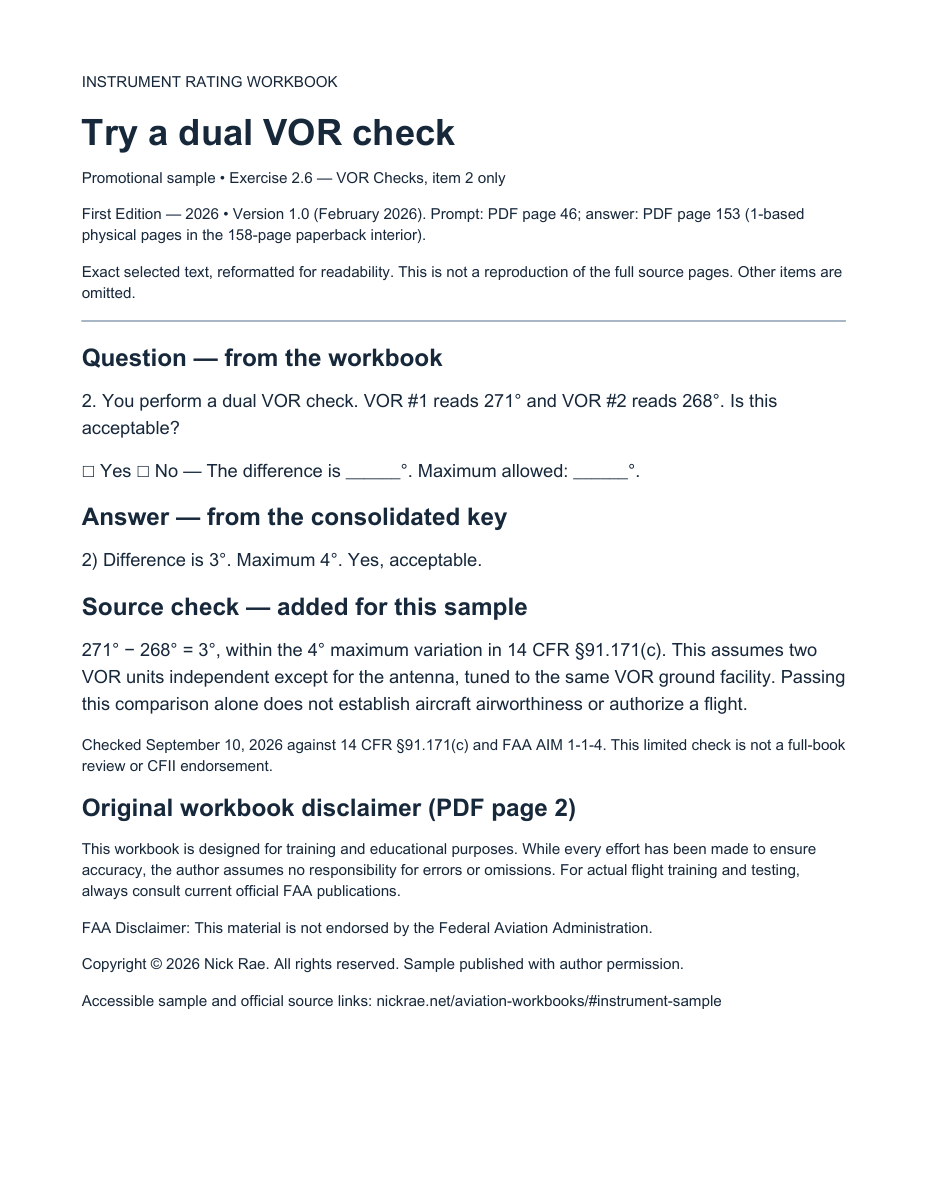
Exercise 2.6 · item 2 only
2. You perform a dual VOR check. VOR #1 reads 271° and VOR #2 reads 268°. Is this acceptable?
☐ Yes ☐ No — The difference is ______°. Maximum allowed: ______°.
Show the workbook answer
2) Difference is 3°. Maximum 4°. Yes, acceptable.
Source context: 14 CFR §91.171(c) permits a maximum 4° variation for two VOR systems independent except for their antenna, tuned to the same ground facility. The 3° difference fits that limit. This comparison alone does not establish airworthiness or authorize a flight.
Regulatory context checked October 13, 2026 for this excerpt only. This is not a full-book review or a CFII endorsement.
Excerpt source: Instrument Rating Workbook, First Edition (2026), Version 1.0 (February 2026). Prompt: physical PDF page 46; answer: page 153 of the 158-page author interior. The downloadable promotional sample retains its September 10, 2026 source-check date. Current retail pagination may differ. Copyright © 2026 Nick Rae; reproduced with author permission.
One useful study session
Give the question some work.
Answer before revealing
Work a small set of questions without the key. Write the applicable limit and the conditions that make it relevant.
Open the controlling source
Check current regulations, the AIM, charts and your actual aircraft documents. A remembered number is only useful in the right context.
Change one assumption
Talk through how a different weather picture, equipment status or clearance changes your answer. Use that discussion with your CFII.
Keep the current sources beside you.
Use this workbook with your instructor, the applicable FAA Airman Certification Standards, current FAA handbooks and your aircraft’s POH/AFM. Published study examples do not replace current regulations, approved procedures or actual flight instruction. No FAA endorsement or checkride result is promised.
A separate free study resource
Ten IFR scenarios. No email required.
The free IFR oral pack offers foundational, source-anchored practice cards. It is a separate study aid, not an excerpt from the workbook.
Choose your study copy
Instrument Rating, in your preferred format.
Paperback and Kindle are separate editions on Amazon. The paperback button below goes to the paperback edition; choose Kindle explicitly if you want the ebook.
Prices, regional availability and retail edition details are controlled by Amazon. The buttons identify each format explicitly.