Nick Rae’s aviation workbook series · 05 / VFR radio calls
Clearance to Confidence: VFR Radio Calls Workbook
Write it. Say it. Say it again.
Turn radio study into out-loud practice. Build a call, anticipate the response, work through the readback and change the situation for another repetition.
Retailer checkout. Confirm current price, availability and selected format on Amazon.
See the sample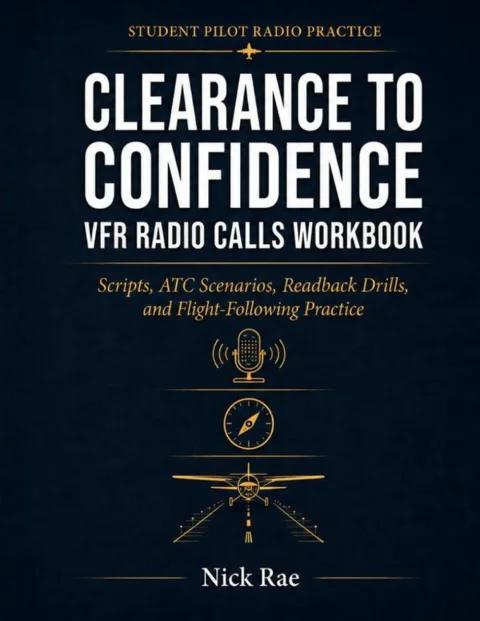
The right fit
What you’ll work on.
For student pilots building comfort on frequency, and returning pilots who want structured VFR radio practice. Use the drills on the ground and discuss local procedures and phrasing with your instructor.
VFR communications practice: call-building, non-towered and towered airport exchanges, traffic advisories, readbacks and recovery from missed information. It is a training aid, not live ATC instruction.
Radio basics
The core call structure, full and abbreviated call signs, numbers, frequencies and asking for a repeat.
Airport conversations
Non-towered airport calls and towered Class D exchanges, followed by busier arrival and sequencing exercises.
Beyond the pattern
VFR flight-following practice and Class C / Class B-style drills.
Readback and recovery
Readback Gym, recovery and emergency-practice sections, and listening tools.
Repeatable page structure
Situation, call-building fields, model exchange, readback trap and a variation; selected sections use their own prompt format.
Topics and the preview are checked against the author’s First Edition manuscript revised May 31, 2026. Check the current retailer listing for the edition and format you intend to buy.
Look before you buy
See a complete call-building drill.
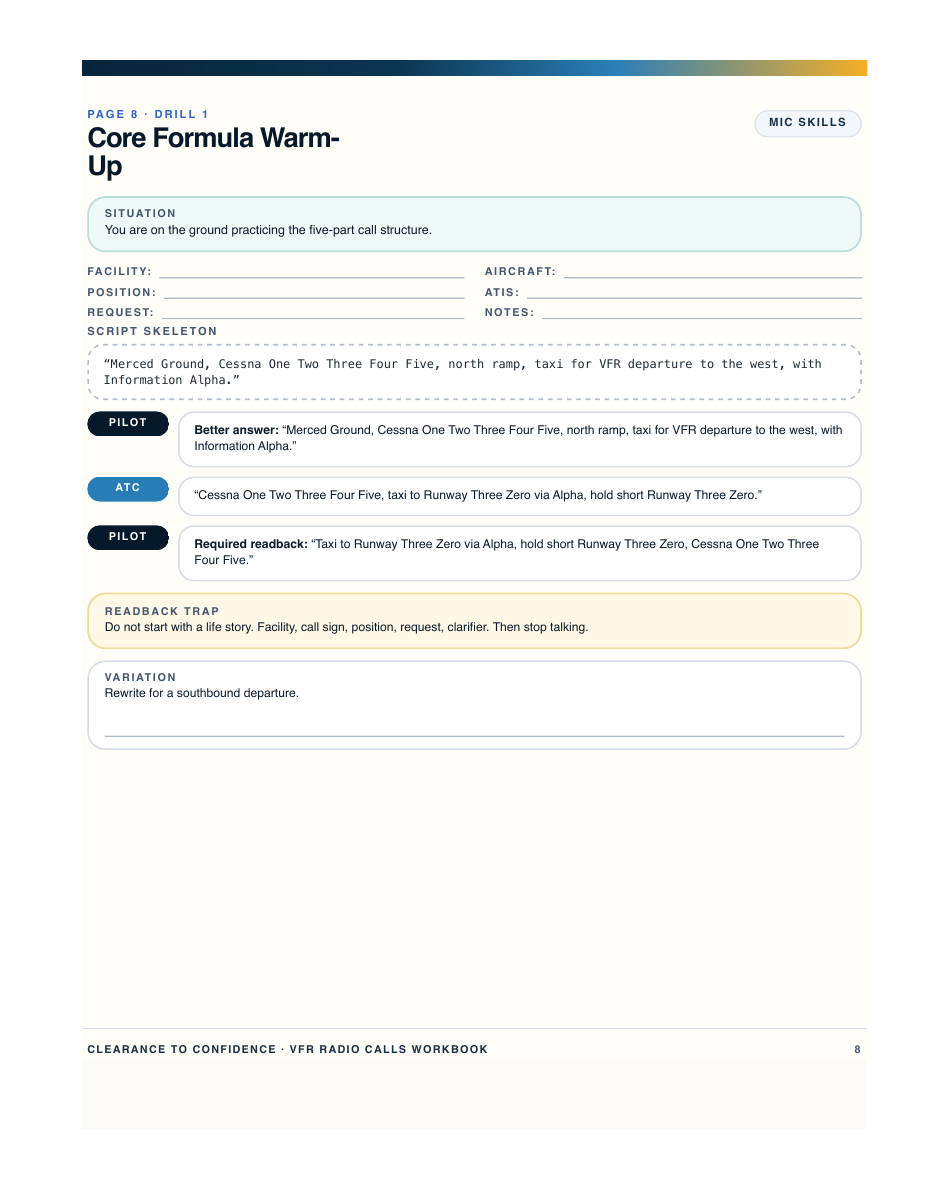
The first drill shows the pattern: a situation, a script, an exchange, a readback trap and a variation to practice.
Ground practice · simulated exchange
Build the call, then vary it.
The page leaves room to identify facility, aircraft, position, ATIS, request and notes. Its variation asks you to rewrite the call for a southbound departure.
Read the drill as text
Situation: You are on the ground practicing the five-part call structure.
Script skeleton / pilot: “Merced Ground, Cessna One Two Three Four Five, north ramp, taxi for VFR departure to the west, with Information Alpha.”
ATC: “Cessna One Two Three Four Five, taxi to Runway Three Zero via Alpha, hold short Runway Three Zero.”
Pilot readback: “Taxi to Runway Three Zero via Alpha, hold short Runway Three Zero, Cessna One Two Three Four Five.”
Readback trap: Do not start with a life story. Facility, call sign, position, request, clarifier. Then stop talking.
Variation: Rewrite for a southbound departure.
This is the book’s simulated practice exchange, not a current Merced clearance, airport diagram or taxi instruction. Use current charts, the AIM, local procedures, actual ATC instructions and your instructor for real operations.
Source: Clearance to Confidence: VFR Radio Calls Workbook, Nick Rae, First Edition, revision May 31, 2026; physical page 8 of the author’s 151-page manuscript. Current retail pagination may differ. Only this page is reproduced here, with author permission. Copyright © 2026 Nick Rae.
One useful study session
Give the question some work.
Read the situation
Identify who you are calling, who you are, where you are and what you want. Use the page’s fields to prepare a concise call.
Speak both sides of the practice exchange
Read the model call and response, then say the pilot’s reply. Slow down when you lose clarity.
Use the variation
Change the detail requested on the page, write your version and repeat it. Confirm real airport details and procedures from current sources before any flight.
Keep the current sources beside you.
Use this workbook with your instructor, the applicable FAA Airman Certification Standards, current FAA handbooks and your aircraft’s POH/AFM. Published study examples do not replace current regulations, approved procedures or actual flight instruction. No FAA endorsement or checkride result is promised.
Choose your study copy
VFR Radio Calls, in your preferred format.
Paperback and Kindle are available through separate Amazon listings. This page offers one small preview; it does not promise a separate printable-workbook download or simulator access.
Prices, regional availability and retail edition details are controlled by Amazon. The buttons identify each format explicitly.