Nick Rae’s aviation workbook series · 03 / Commercial pilot
The Complete Commercial Pilot Workbook
Practice commercial-level explanations.
Connect written-test review, oral questions and flight scenarios. Make your study session about the reasoning you can explain, then discuss it with the instructor who knows your training.
Retailer checkout. Confirm current price, availability and selected format on Amazon.
See the manuscript sample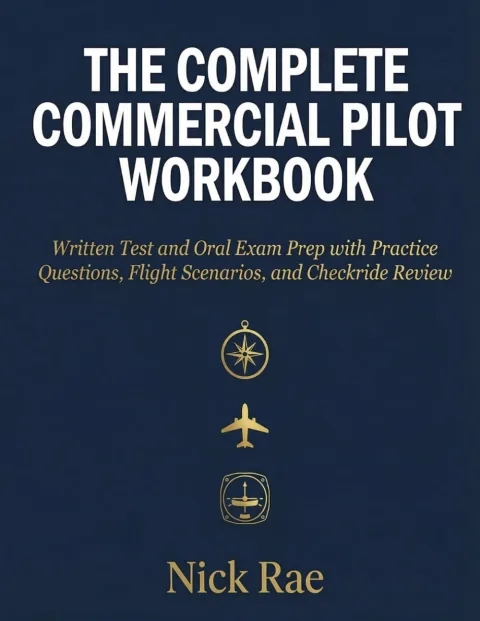
The right fit
What you’ll work on.
For airplane single-engine land (ASEL) commercial applicants working through knowledge review and checkride preparation. It can also help organize the questions you want to discuss before your next training lesson.
ASEL commercial study. The published launch description identifies written and oral practice, flight scenarios, maneuver review sheets and a practice knowledge test. Multi-engine add-on preparation has its own workbook.
Knowledge-test review
Practice questions and a full practice knowledge test, with attention to the explanation behind an answer.
Oral preparation
Commercial-focused questions that invite a spoken explanation rather than recognition alone.
Flight scenarios and judgment
Study situations that connect knowledge with the decisions discussed during commercial training.
Maneuver review
Review sheets to organize ground preparation before instructor-led flight practice.
ASEL focus
A commercial-airplane study scope that is explicitly single-engine land; use the separate Multi-Engine workbook for its PA-44 add-on focus.
This workbook focuses on ASEL commercial preparation. Check the retail edition and selected format on Amazon before buying.
Look before you buy
See how commercial judgment is practiced.
Four complete manuscript pages move from decision making to weather scenarios, then ten practice questions with explained answers. Read a scenario, make your own call, and compare the reasoning.
PDF · four source pages plus a source-and-study-context page. No email required.
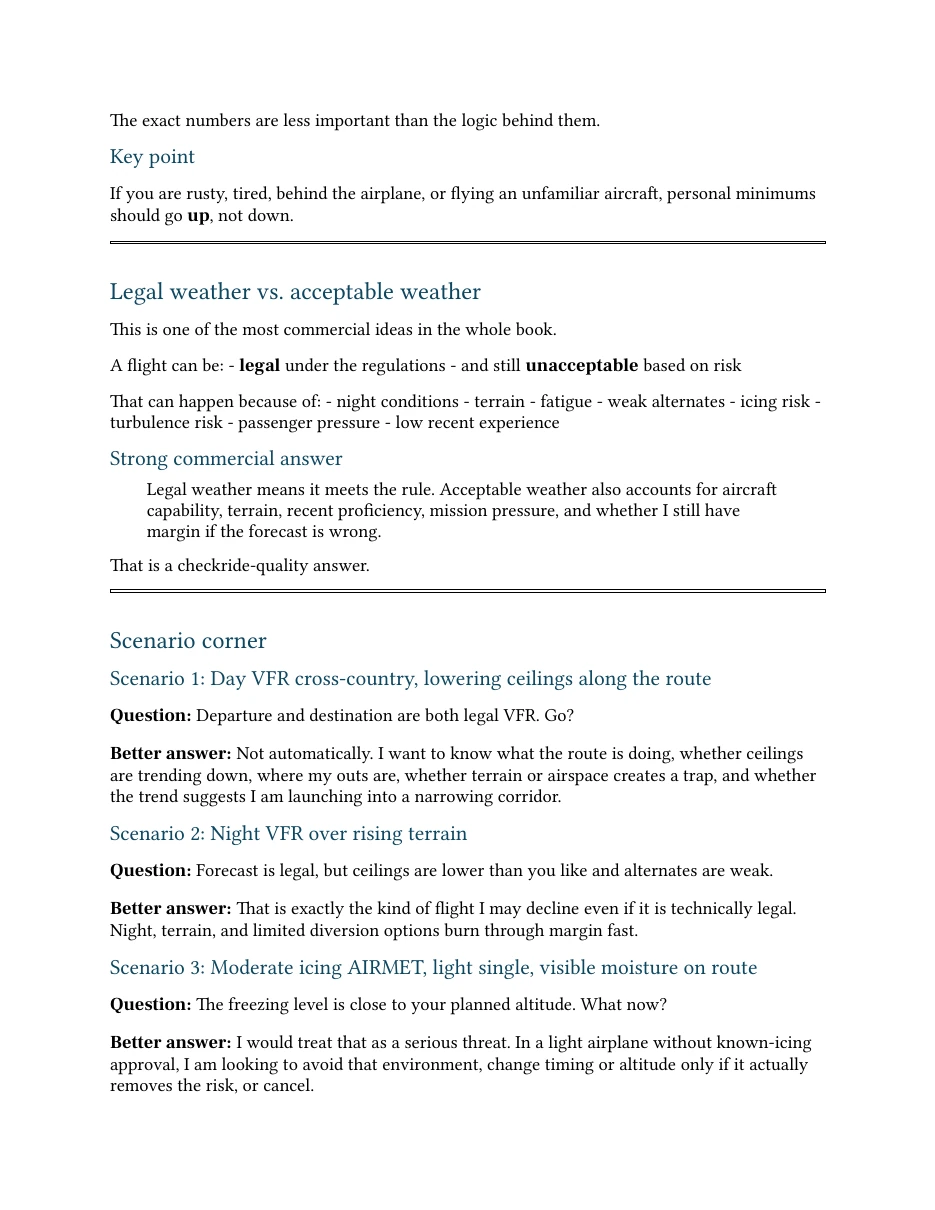
One scenario from the sample
Legal VFR at both ends. Is that enough?
“Departure and destination are both legal VFR. Go?”
The source answer looks beyond the two airport reports: conditions along the route, falling ceilings, terrain, escape options and the weather trend. The full excerpt also shows how external pressure can affect a decision.
This is ground-study material. The personal weather minimums on source page 30 are illustrative author examples, not recommended limits for your flight. Use current weather information, aircraft documents and your instructor’s guidance for actual planning.
View the other three complete manuscript pages
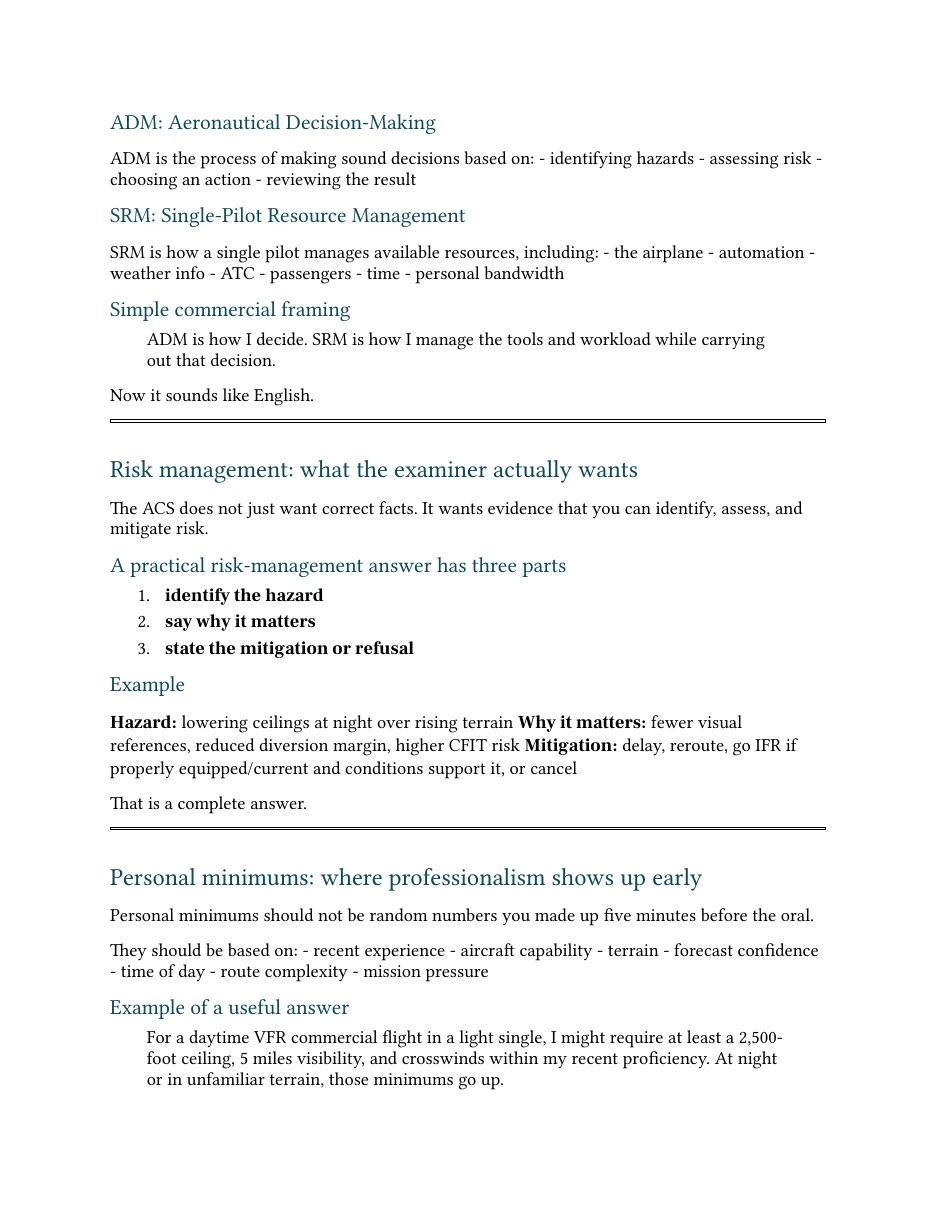
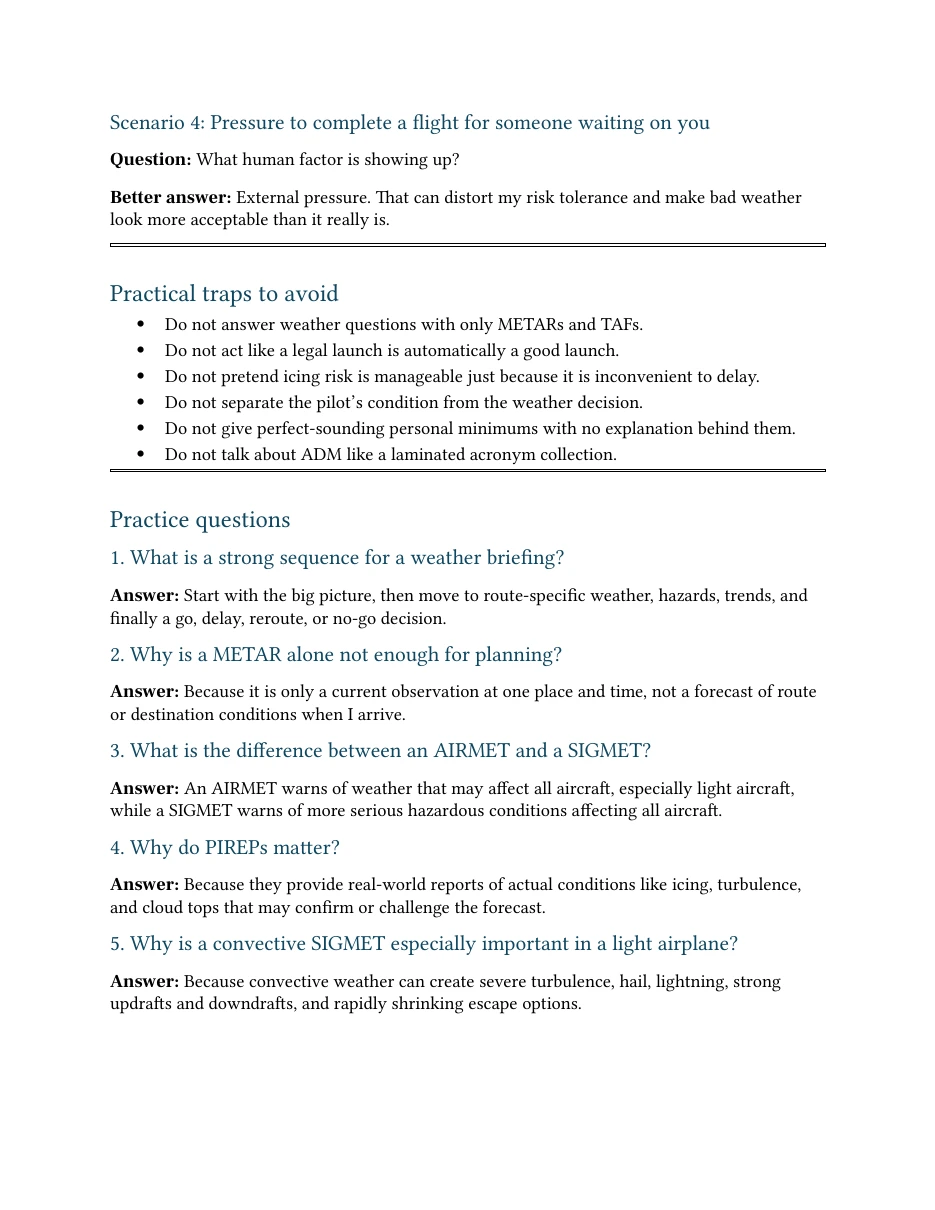
Read all four sample pages as text
ADM: Aeronautical Decision-Making
ADM is the process of making sound decisions based on: - identifying hazards - assessing risk - choosing an action - reviewing the result
SRM: Single-Pilot Resource Management
SRM is how a single pilot manages available resources, including: - the airplane - automation - weather info - ATC - passengers - time - personal bandwidth
Simple commercial framing
ADM is how I decide. SRM is how I manage the tools and workload while carrying out that decision.
Now it sounds like English.
Risk management: what the examiner actually wants
The ACS does not just want correct facts. It wants evidence that you can identify, assess, and mitigate risk.
A practical risk-management answer has three parts
identify the hazard
say why it matters
state the mitigation or refusal
Example
Hazard: lowering ceilings at night over rising terrain Why it matters: fewer visual references, reduced diversion margin, higher CFIT risk Mitigation: delay, reroute, go IFR if properly equipped/current and conditions support it, or cancel
That is a complete answer.
Personal minimums: where professionalism shows up early
Personal minimums should not be random numbers you made up five minutes before the oral.
They should be based on: - recent experience - aircraft capability - terrain - forecast confidence - time of day - route complexity - mission pressure
Example of a useful answer
For a daytime VFR commercial flight in a light single, I might require at least a 2,500-foot ceiling, 5 miles visibility, and crosswinds within my recent proficiency. At night or in unfamiliar terrain, those minimums go up.
The exact numbers are less important than the logic behind them.
Key point
If you are rusty, tired, behind the airplane, or flying an unfamiliar aircraft, personal minimums should go up, not down.
Legal weather vs. acceptable weather
This is one of the most commercial ideas in the whole book.
A flight can be: - legal under the regulations - and still unacceptable based on risk
That can happen because of: - night conditions - terrain - fatigue - weak alternates - icing risk - turbulence risk - passenger pressure - low recent experience
Strong commercial answer
Legal weather means it meets the rule. Acceptable weather also accounts for aircraft capability, terrain, recent proficiency, mission pressure, and whether I still have margin if the forecast is wrong.
That is a checkride-quality answer.
Scenario corner
Scenario 1: Day VFR cross-country, lowering ceilings along the route
Question: Departure and destination are both legal VFR. Go?
Better answer: Not automatically. I want to know what the route is doing, whether ceilings are trending down, where my outs are, whether terrain or airspace creates a trap, and whether the trend suggests I am launching into a narrowing corridor.
Scenario 2: Night VFR over rising terrain
Question: Forecast is legal, but ceilings are lower than you like and alternates are weak.
Better answer: That is exactly the kind of flight I may decline even if it is technically legal. Night, terrain, and limited diversion options burn through margin fast.
Scenario 3: Moderate icing AIRMET, light single, visible moisture on route
Question: The freezing level is close to your planned altitude. What now?
Better answer: I would treat that as a serious threat. In a light airplane without known-icing approval, I am looking to avoid that environment, change timing or altitude only if it actually removes the risk, or cancel.
Scenario 4: Pressure to complete a flight for someone waiting on you
Question: What human factor is showing up?
Better answer: External pressure. That can distort my risk tolerance and make bad weather look more acceptable than it really is.
Practical traps to avoid
Do not answer weather questions with only METARs and TAFs.
Do not act like a legal launch is automatically a good launch.
Do not pretend icing risk is manageable just because it is inconvenient to delay.
Do not separate the pilot’s condition from the weather decision.
Do not give perfect-sounding personal minimums with no explanation behind them.
Do not talk about ADM like a laminated acronym collection.
Practice questions
1. What is a strong sequence for a weather briefing?
Answer: Start with the big picture, then move to route-specific weather, hazards, trends, and finally a go, delay, reroute, or no-go decision.
2. Why is a METAR alone not enough for planning?
Answer: Because it is only a current observation at one place and time, not a forecast of route or destination conditions when I arrive.
3. What is the difference between an AIRMET and a SIGMET?
Answer: An AIRMET warns of weather that may affect all aircraft, especially light aircraft, while a SIGMET warns of more serious hazardous conditions affecting all aircraft.
4. Why do PIREPs matter?
Answer: Because they provide real-world reports of actual conditions like icing, turbulence, and cloud tops that may confirm or challenge the forecast.
5. Why is a convective SIGMET especially important in a light airplane?
Answer: Because convective weather can create severe turbulence, hail, lightning, strong updrafts and downdrafts, and rapidly shrinking escape options.
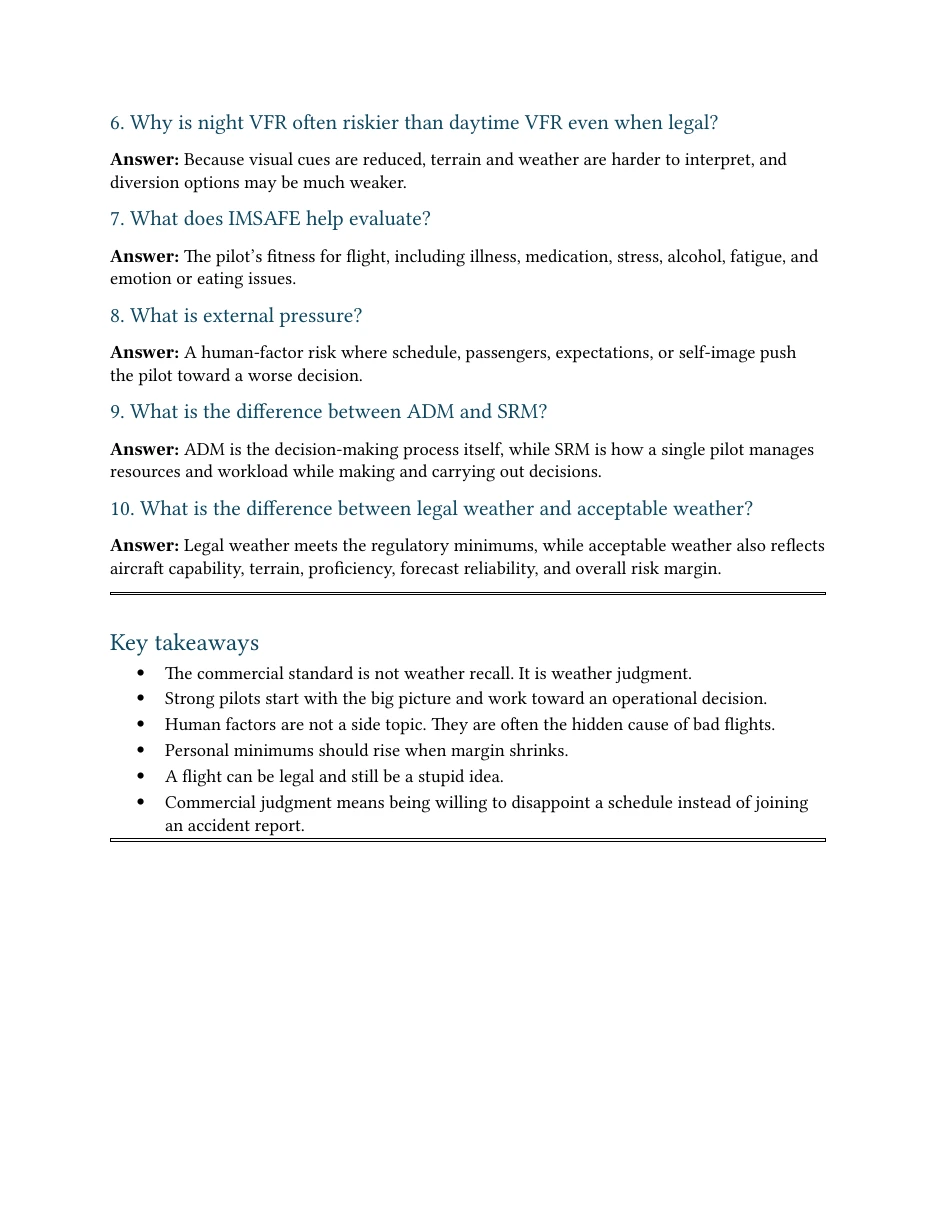
6. Why is night VFR often riskier than daytime VFR even when legal?
Answer: Because visual cues are reduced, terrain and weather are harder to interpret, and diversion options may be much weaker.
7. What does IMSAFE help evaluate?
Answer: The pilot’s fitness for flight, including illness, medication, stress, alcohol, fatigue, and emotion or eating issues.
8. What is external pressure?
Answer: A human-factor risk where schedule, passengers, expectations, or self-image push the pilot toward a worse decision.
9. What is the difference between ADM and SRM?
Answer: ADM is the decision-making process itself, while SRM is how a single pilot manages resources and workload while making and carrying out decisions.
10. What is the difference between legal weather and acceptable weather?
Answer: Legal weather meets the regulatory minimums, while acceptable weather also reflects aircraft capability, terrain, proficiency, forecast reliability, and overall risk margin.
Key takeaways
The commercial standard is not weather recall. It is weather judgment.
Strong pilots start with the big picture and work toward an operational decision.
Human factors are not a side topic. They are often the hidden cause of bad flights.
Personal minimums should rise when margin shrinks.
A flight can be legal and still be a stupid idea.
Commercial judgment means being willing to disappoint a schedule instead of joining an accident report.
Excerpt from Nick Rae’s The Complete Commercial Pilot Workbook manuscript, pages 30–33 counted from the first document page. Retail layout and pagination may differ. Copyright © 2026 Nick Rae.
Keep the Commercial Pilot ACS, FAA Risk Management Handbook and AIM weather guidance beside you as you study.
One useful study session
Give the question some work.
Start with a training objective
Choose one knowledge area or maneuver from your instructor’s plan. Make a short list of questions you cannot yet explain clearly.
Pair the written and spoken answer
Work the practice question, then say the reasoning out loud. Note where you need a regulation, aircraft limitation or current ACS reference.
Debrief after the lesson
Compare your written preparation with the instructor’s feedback. Turn the remaining gaps into the next small study session.
Keep the current sources beside you.
Use this workbook with your instructor, the applicable FAA Airman Certification Standards, current FAA handbooks and your aircraft’s POH/AFM. Published study examples do not replace current regulations, approved procedures or actual flight instruction. No FAA endorsement or checkride result is promised.
Choose your study copy
Commercial Pilot, in your preferred format.
Choose the paperback or Kindle listing below, then confirm the selected edition, current price and sample availability on Amazon. No instructor endorsement or checkride outcome is promised.
Prices, regional availability and retail edition details are controlled by Amazon. The buttons identify each format explicitly.