Nick Rae’s aviation workbook series · 04 / Multi-engine add-on
Multi-Engine Add-On Rating Workbook
Know the airplane behind the answer.
Give systems, performance and one-engine-inoperative study a focused place in your preparation. This PA-44 Seminole-oriented workbook belongs beside your aircraft documents and instructor’s plan.
Retailer checkout. Confirm current price, availability and selected format on Amazon.
See the manuscript sample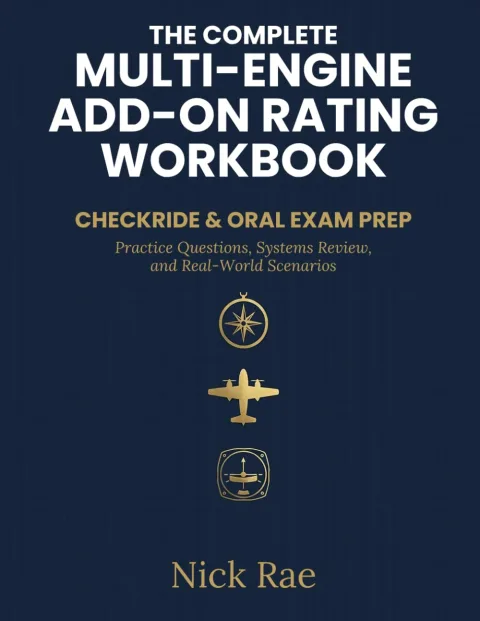
The right fit
What you’ll work on.
For pilots adding multi-engine privileges, especially those training in a PA-44 Seminole environment. It is intended for ground study and oral preparation alongside the flight training required for the add-on.
PA-44-focused multi-engine study. Aircraft-specific speeds, limitations, procedures and performance must come from your actual POH/AFM, approved checklists and instructor; a study workbook cannot set them for your aircraft.
V-speeds and systems
Organize the speeds and systems you need to explain, and connect them to your actual airplane’s documents.
Vmc and asymmetric thrust
Review the concepts and factors discussed during multi-engine training without treating a demonstration as an unsupervised exercise.
One-engine-inoperative operations
Ground-study prompts for engine-out procedures, single-engine decisions and OEI approaches.
Performance and judgment
Prepare to discuss runway, conditions and aircraft performance with your instructor rather than relying on a generic rule.
Add-on oral preparation
PA-44 Seminole framing and commercial-add-on knowledge review, as described in the author-supplied manuscript.
This topic overview follows the author-supplied Multi-Engine manuscript. It does not supply operating limitations, memory items or an aircraft checklist.
Look before you buy
See the preparation and review style.
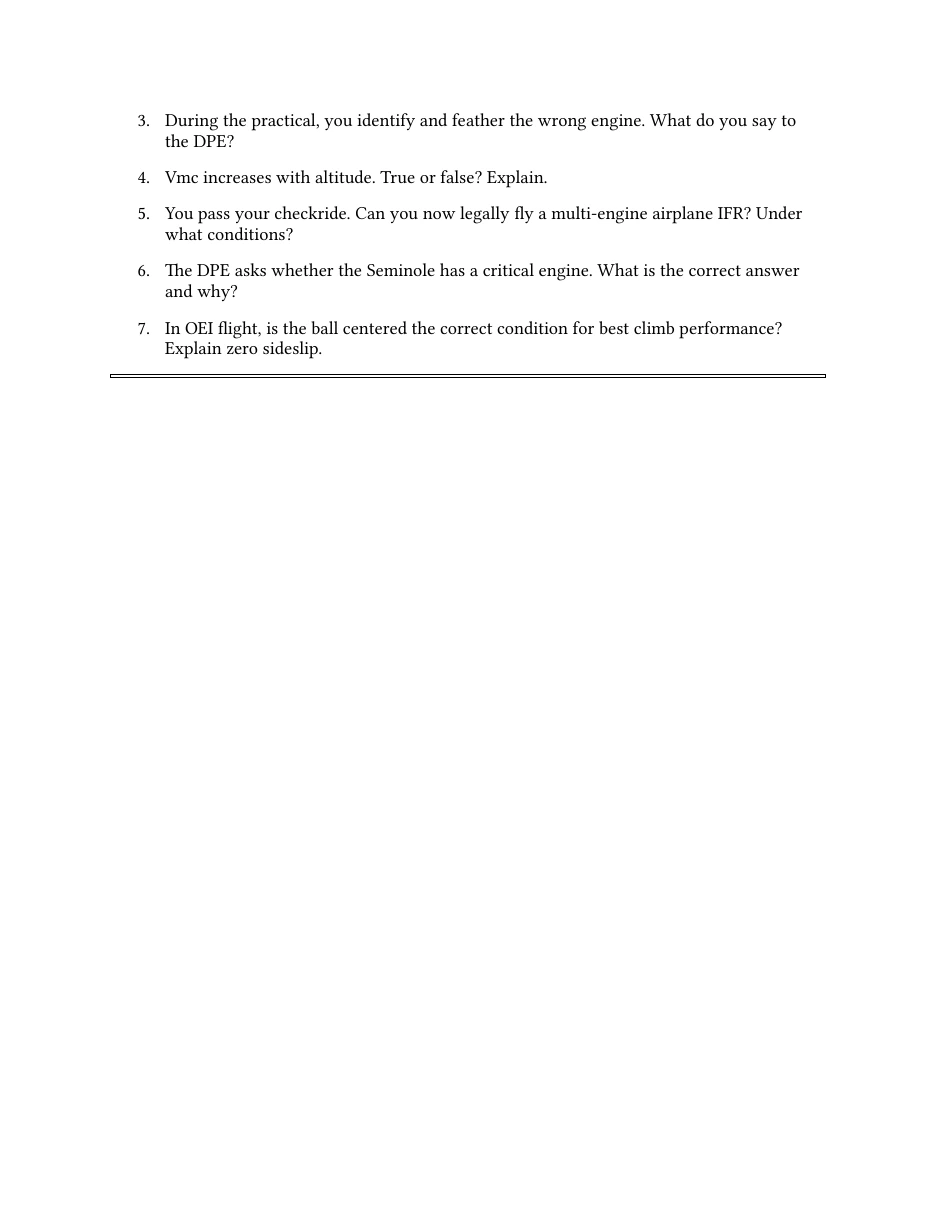
Two complete, noncontiguous manuscript pages show a preparation checklist, oral-study guidance and five questions from a longer self-check. Use the prompts to start a ground-study conversation with your instructor.
Preparation checklist context: the source checklist is not exhaustive; current FAA prerequisites control. The FAA ACS Companion Guide, Section 7, includes a medical certificate or BasicMed qualification when applicable. Confirm the documents and eligibility that apply to your test with your instructor and evaluator.
PDF · two selected source pages plus a source-and-study-context page. No email required.
From the review page
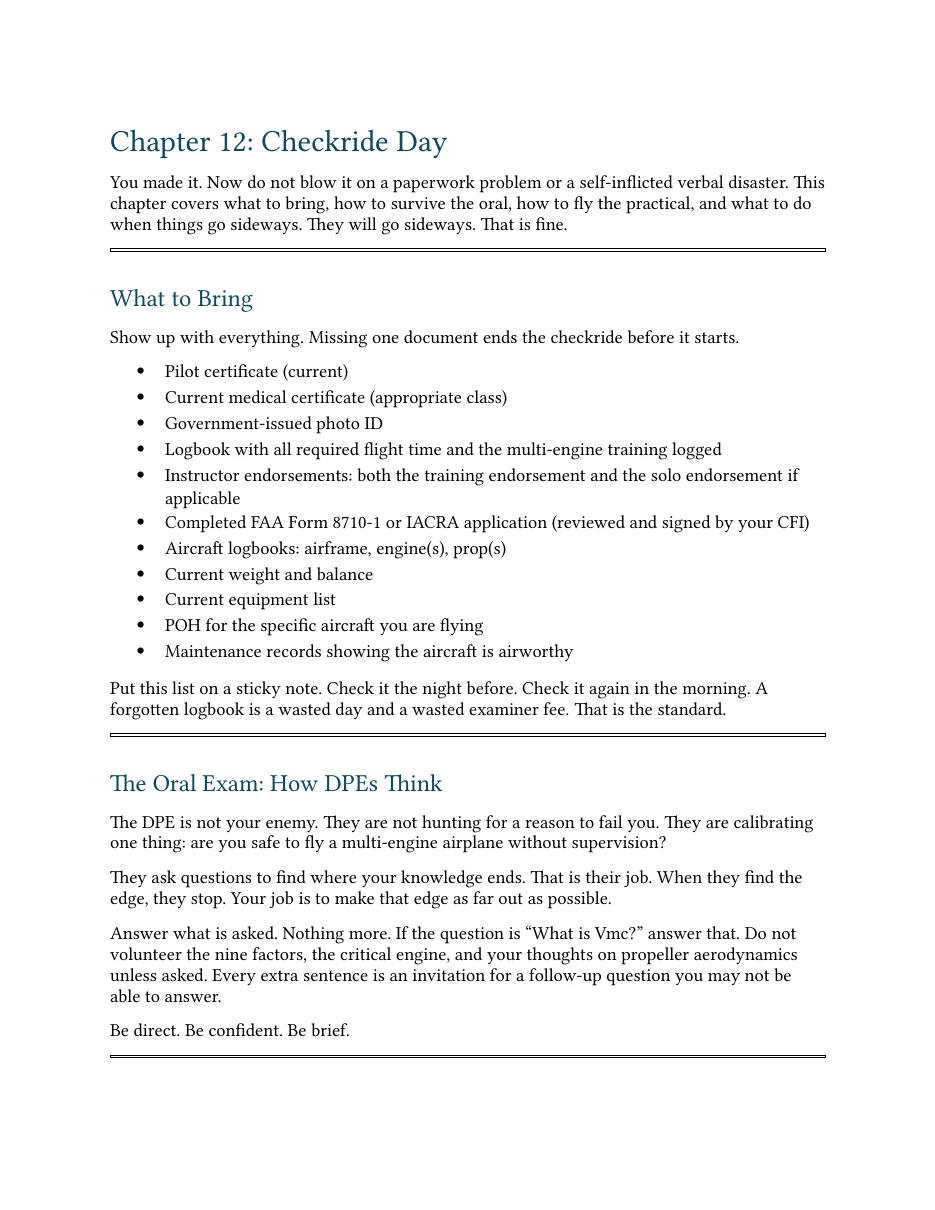
Explain your answer out loud.
Source page 111 contains questions 3–7 from a longer exercise. The selected page preserves those five prompts; the sample does not add model answers or reproduce the intervening pages.
- During the practical, you identify and feather the wrong engine. What do you say to the DPE?
- Vmc increases with altitude. True or false? Explain.
- You pass your checkride. Can you now legally fly a multi-engine airplane IFR? Under what conditions?
- The DPE asks whether the Seminole has a critical engine. What is the correct answer and why?
- In OEI flight, is the ball centered the correct condition for best climb performance? Explain zero sideslip.
These are discussion questions, not statements to memorize or in-flight instructions. Resolve your answers with the current applicable ACS, FAA references, actual aircraft POH/AFM and instructor.
View the complete review-question page
Read the preparation page as text
Chapter 12: Checkride Day
You made it. Now do not blow it on a paperwork problem or a self-inflicted verbal disaster. This chapter covers what to bring, how to survive the oral, how to fly the practical, and what to do when things go sideways. They will go sideways. That is fine.
What to Bring
Show up with everything. Missing one document ends the checkride before it starts.
Pilot certificate (current)
Current medical certificate (appropriate class)
Government-issued photo ID
Logbook with all required flight time and the multi-engine training logged
Instructor endorsements: both the training endorsement and the solo endorsement if applicable
Completed FAA Form 8710-1 or IACRA application (reviewed and signed by your CFI)
Aircraft logbooks: airframe, engine(s), prop(s)
Current weight and balance
Current equipment list
POH for the specific aircraft you are flying
Maintenance records showing the aircraft is airworthy
Put this list on a sticky note. Check it the night before. Check it again in the morning. A forgotten logbook is a wasted day and a wasted examiner fee. That is the standard.
The Oral Exam: How DPEs Think
The DPE is not your enemy. They are not hunting for a reason to fail you. They are calibrating one thing: are you safe to fly a multi-engine airplane without supervision?
They ask questions to find where your knowledge ends. That is their job. When they find the edge, they stop. Your job is to make that edge as far out as possible.
Answer what is asked. Nothing more. If the question is “What is Vmc?” answer that. Do not volunteer the nine factors, the critical engine, and your thoughts on propeller aerodynamics unless asked. Every extra sentence is an invitation for a follow-up question you may not be able to answer.
Be direct. Be confident. Be brief.
Excerpt from Nick Rae’s Multi-Engine Add-On Rating Workbook manuscript, pages 107 and 111 counted from the first document page. Retail layout and pagination may differ. Copyright © 2026 Nick Rae.
One useful study session
Give the question some work.
Put the correct POH beside the workbook
Identify the airplane and document revision used in your training. Mark where an answer needs aircraft-specific information.
Explain before rehearsing
Discuss systems and performance on the ground. Learn and practice actual procedures through your instructor’s training plan.
Debrief the differences
Write down what changed with conditions or configuration and which source settles the answer. Use those notes in your next oral-review session.
Keep the current sources beside you.
Use this workbook with your instructor, the applicable FAA Airman Certification Standards, current FAA handbooks and your aircraft’s POH/AFM. Published study examples do not replace current regulations, approved procedures or actual flight instruction. No FAA endorsement or checkride result is promised.
Choose your study copy
Multi-Engine, in your preferred format.
Both paperback and Kindle have their own Amazon listings. Confirm the edition and available preview, then check that the PA-44 focus suits your training aircraft and goals.
Prices, regional availability and retail edition details are controlled by Amazon. The buttons identify each format explicitly.